🚀 Excited to share that the 2026 RRS Rocket and Space Symposium is happening this Saturday, April 18! Open to all ages!!!
This event brings together space enthusiasts, students, and industry professionals for a full day of engaging talks, hands-on activities, and exhibits focused on rockets and space exploration.
Check out the speaker sessions below.
It’s a great opportunity to learn from experts, connect with others in the field, and explore the latest ideas and innovations shaping the future of space.
🎟️ Free tickets are available—don’t miss out on this inspiring experience!!
The Executive Council of the RRS will be setting up for the 2026 Symposium on April 17th, at Mary Star of the Seal high school.
In hopes of increasing participation in the setup, the Executive Council has decided to cancel the April monthly meeting. A presentation detailing our activities over the past month will instead be added as a addendum to this post at a later time.
4/23/2026: The would-be presentation for this meeting can be found here.
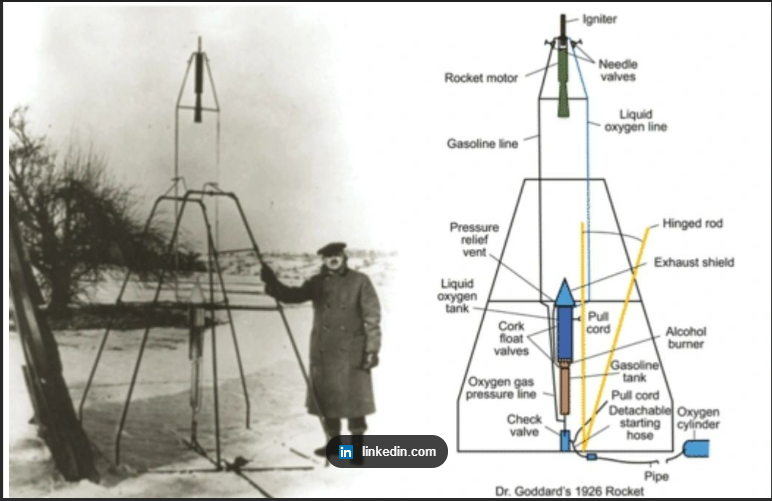
A century ago, on March 16, 1926, on a snowy field at the Ward farm in Auburn, Massachusetts, an experimental device built by a Clark University physics professor, Robert Hutchings Goddard, made history being the first liquid-fueled rocket to fly. Powered by gasoline and liquefied oxygen, the humble craft flew a modest 41 feet in altitude and 184 feet downrange after a few initial unsuccessful attempts. From this first flight to the start of the American involvement in the second world war in 1941, him and his team made a total of 34 pioneering flights. It wasn’t until after the second world war that his achievements were more fully appreciated and recognized earning him the title of the Father of Modern Rocketry.
Goddard’s early university research with black powder rockets, vacuum hot-fire tests and the use of a de Laval nozzle produced a small rocket engine far more efficient that it’s predecessors in the 1920’s. His seminal work, A Method for Reaching Extreme Altitudes, first published in 1919 by the Smithsonian Press, was pivotal. Goddard recognized that lighter structures would result in higher final velocities and recognized the value of staging to reaching higher overall altitudes by shedding dead weight along the flight. His work also recognized the value of two-axis gyroscopic stabilization as a means to achieve straighter and more accurate flights. Higher temperatures and better combustion efficiency possible with liquid fuels would make for smaller combustion chambers. Goddard’s notes indicated hydrogen and oxygen having the highest combustion efficiency, but in his first flight, the use of a common and relatively well understood hydrocarbon fuel such as automotive gasoline was likely a reasonable choice. He conducted experiments with gasoline and oxygen combustion starting in 1921 and had a working engine by 1923.
The physical arrangement of Goddard’s first liquid rocket, named “Nell”, was unusual by what is considered common practice today. The combustion chamber with a very long shallow-angle nozzle was at the top with the propellant tanks at the bottom, thus the engine was pulling itself up with the tanks trailing behind. It was thought this arrangement would be more stable in flight. The injection and mixing of propellants in a chamber ahead of a converging path leading to the constriction of the throat area was a major advancement. Owing to conservatism to avoid flow separation of the expected supersonic flow in the downstream diverging portion of the nozzle, the half-angle was very small as was common for the early experiments prior to more detailed knowledge of nozzle geometry. The liquefied oxygen tank sat above the gasoline tank. Wisely, the oxygen tank had a relief valve and a conical hat on top of the oxidizer likely to better divide the exhaust flow. The hot exhaust from the nozzle impinging down on the oxidizer tank would heat the liquid oxygen creating more gas flow to the chamber. His design sought to pressurize the propellants to help feed them by separate fuel and oxidizer lines upward into the combustion chamber. The burning of alcohol-soaked rags surrounding the oxygen tank were used to improve the oxygen gas flow to the combustion chamber. Needle valves in the line offered some ability to balance the relative flow rates into the chamber. The igniter used in the first liquid rocket flight was a closed charge of match heads and black powder that was externally heated by a blow torch on a long pole held by an assistant, Henry Sachs, to achieve ignition and flight. Clark University digital archival documents may have some better descriptions of how operations took place.
Later designs as seen in photographs would put the engine at the bottom and tanks forward with tapered nose shapes and care paid to achieving lower aerodynamic drag, higher exhaust velocities and of course higher mass fractions for greater delta-V.
One of the more common questions asked about this 1926 flight was where Dr. Goddard acquired his liquid oxygen. Most likely he acquired it through a commercial supplier, likely what is known today as the Linde Air Products Company. The first Linde plant in the US, an American subsidiary company of the German company, Linde AG, was located in Buffalo, New York, and offered liquid oxygen in 1907. Today, Linde PLC exists from the 2018 merger of the original Linde AG company and Praxair. The details of his handling and loading procedures for the liquid oxygen is something that the society is seeking to discover purely for historical context.
Owing to public ridicule and widespread fundamental misunderstandings of his work, Goddard became very reclusive and many of his achievements were only recognized in the latter years of his life and after his death. Many were inspired by his 1919 monograph, but very quickly uninformed speculation by others led to absurd assertions leading others to deride the young scientist’s work. Most infamously the New York Times claiming “rockets would never work in the vacuum of space” and Goddard was “lacking the knowledge ladled out daily in high schools” only to be serving a post-humous retraction and apology to Goddard 24 years after his death coinciding with the American moon landing in 1969.
Despite some success with the US Army in making portable artillery rockets and an early version of the bazooka, Goddard was very guarded about his work owing to concerns about his inventions being stolen by others including potential funding from companies despite several patent filings. He did much of his later work in relative secrecy in Roswell, New Mexico. Interest in rocketry in the US prior to the second world war was also very modest in contrast to the German government at the time seeking an alternative to traditional guns and artillery pieces limited by armistice agreements at that time. Goddard managed to secure modest funding from a variety of sources throughout the years including the Smithsonian, aviation clubs, the Guggenheim family and famous aviator, Charles Lindbergh, but the amounts considered quite large at the time by researchers were paltry compared to the state funding the Germans secured in the years leading up the second world war. Several groups over the years took note of Goddard’s work but collaboration was slight if not absent.
German rocketry in the 1930’s certainly took notice of Goddard’s work and advanced the science significantly in the years leading to the world’s first ballistic missile, the V-2 (named the A-4 by the Germans). Von Braun and his team took careful notice of Goddard’s work saying Goddard’s work “blazed the trail” for his team to make rapid advancements in Germany. Goddard’s aspirations, like many of the other pioneers of his time including Von Braun, were concerned with space travel starting with exploring and measuring the upper atmosphere. An anecdote I once heard was that when Von Braun was brought to the United States, he was initially surprised how little work was done here, quipping “after all, you had Robert Goddard?” It’s not clear if this anecdote or quote is actually true, but I found it amusing to hear.
After nations realized the potentially devastating effect the V-2 rocket had in the second world war, rocketry and ballistic missiles would become a game-changing technology in late 20th century warfare garnering massive investments in money and materials. Resulting from lessons of the second world war ending in 1945, the ballistic missile era would begin in the early days of the Cold War that follows and in parallel with the founding of NASA and the Space Age in the United States and similarly with the allied nations of Europe and in the Soviet Union. The initial Space Age would lead to further achievements such as the Soviet Union putting the first satellite in full orbit (1958), the first man in orbit (1961), and later the first woman in orbit (1963), followed by lunar probe soft landings (1966) and just 11 years later after Sputnik the first two of twelve American men landing on the moon in six different missions by the United States starting in 1969. Robert Goddard’s work in liquid rocketry being recognized as the seed that would enable the technology making all of this possible.
While some honors and recognition were bestowed on Goddard before his death in 1945, his contribution to science became more widely appreciated in the years and decades thereafter. The NASA facility, Goddard Space Flight Center in Greenbelt, Maryland, bears his name.
Two quotes from Goddard are given below which are something that I found to be particularly relevant even today in the early 21st century:
It is difficult to say what is impossible, for the dream of yesterday is the hope of today and the reality of tomorrow. Just remember – when you think all is lost, the future remains. The reason people fail is not for lack of vision but for lack of resolve and resolve is born out of counting the cost.
Every vision is a joke until the first man accomplishes it; once realized it becomes commonplace.
It’s worth noting that Estes Rockets launched a special hobby rocket kit replicating the initial Goddard rocket design for about $32 USD. This could be a little celebratory fun at the RRS MTA at our next event.
The RRS honors Robert Goddard in this modest but exemplary achievement in human history. The society was glad to see many well written articles throughout the internet, including one on LinkedIn, honoring this century milestone on Monday, March 16, 2026. This article posted today represents the society’s tribute to one of the most consequential experiments leading to the dawn of the Space Age.
For more information on the Reaction Research Society, please visit our website at RRS.ORG or contact the RRS president by email at: president@rrs.org
Also, the RRS would like to advertise our 83rd anniversary symposium to be held Saturday, April 18, 2026, at the Mary Star of the Sea High School in San Pedro, California. This all-day event will have speakers and exhibits related to amateur and professional rocketry. More information will be posted and can be found by contacting the RRS.